Thailand Records Highest Inflation in Three Years Amid Rising Oil Prices
Thailand recorded its highest inflation rate in three years in April as rising global oil prices began affecting consumer costs across the country. Although inflation remains moderate compared to many other economies, the latest figures mark a significant shift for Thailand, where inflation had still been negative as recently as March.

According to the Trade Policy and Strategy Office (TPSO), Thailand’s Consumer Price Index (CPI) increased by 2.89% year-on-year in April and rose 2.75% compared to March. For the January–April period, overall inflation stood at 0.32%.
Analysts noted that higher energy costs are now gradually spreading into the prices of goods and services throughout the economy. The country’s Core CPI, which excludes food and energy products, climbed 0.83% year-on-year in April and 0.41% month-on-month. During the first four months of 2026, Core CPI increased by 0.64%.
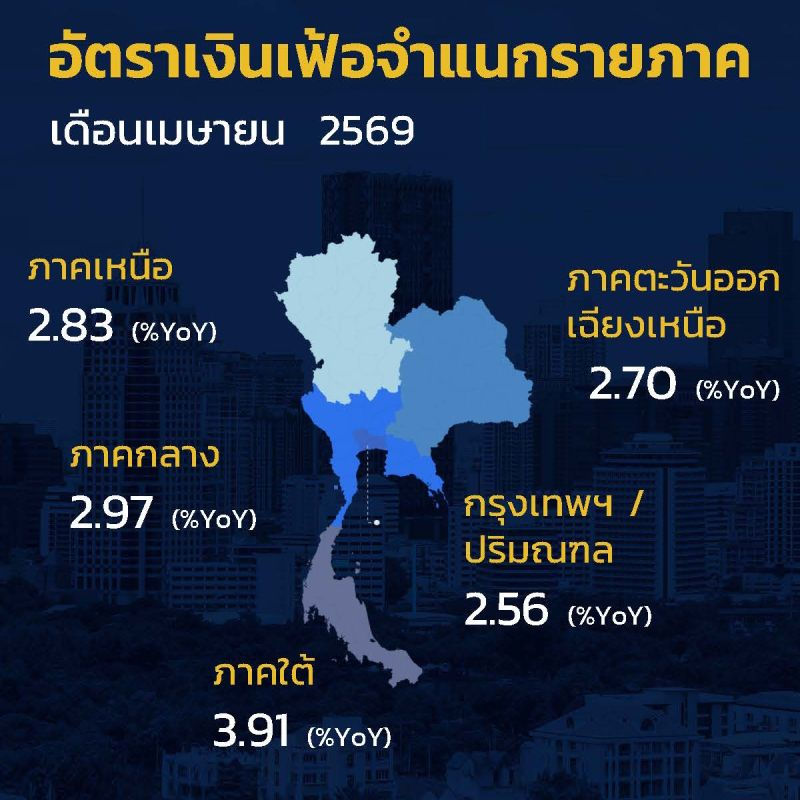
Southern Thailand experienced the sharpest rise in consumer prices, with regional inflation reaching 3.91% compared to April last year. Other regions recorded increases ranging from 2.56% to 2.97%.
Despite the broader inflation trend, price growth was not universal across all sectors. Of the 424 product and service categories monitored by the authorities, prices increased in 251 categories, remained unchanged in 42, and declined in 171.
Among the products and services that became more expensive in April were jasmine rice, fresh chicken, eggs, limes, instant coffee, bottled drinking water, ready-made meals, school transportation, residential rent, international airfares, and fuel.
Meanwhile, prices fell for sticky rice, cabbage, fresh chili, shallots, garlic, mangoes, electricity bills, skincare products, shampoo, soap, deodorants, and several other consumer goods.

TPSO analysts expect inflationary pressure to continue into May. However, forecasts for the full year remain tied closely to global oil market conditions.
Authorities outlined two possible scenarios for 2026. Under the more optimistic outlook, annual inflation would range between 1.5% and 2.5%. Under the less favorable scenario, inflation could rise to between 2.5% and 3.5%.
Both forecasts assume crude oil prices stabilize within the range of US$70–80 per barrel and that prices above US$100 per barrel do not become the new normal for global energy markets.


Comments