Phuket’s Peranakan Wedding Festival Revives Centuries-Old Chinese Traditions
The annual Phuket Baba Wedding Festival transformed Phuket Old Town into a celebration of Peranakan heritage on May 17, bringing together couples, locals, and visitors for traditional Chinese-style wedding ceremonies rooted in centuries of cultural history.

This year marked the 13th edition of the event since Phuket’s Peranakan community launched the festival as both a cultural preservation initiative and a tourism attraction. The 2026 theme, translated as “Fragments of a Glorious Past: A Baba Wedding as a Timeless Symbol of Love,” highlighted the enduring traditions of the Baba Nyonya community.
Among the distinguished guests attending the event were Phuket Vice Governor Adun Chuthong and his wife, Dr. Khemmavan Chuthong, vice-president of the Phuket Red Cross; president of the Peranakan Association of Thailand Dr. Koson Tanguthai; and former Phuket governor Sophon Suwannarat with his wife Bussadi Suwannarat.
The centrepiece of the celebration was a colourful street parade featuring participants dressed in traditional Peranakan attire. The procession began at Sino House Phuket, symbolically representing the groom’s family residence, before continuing through Phuket Old Town to the historic Ang Mo Lao mansion, home of the Hongyok family.
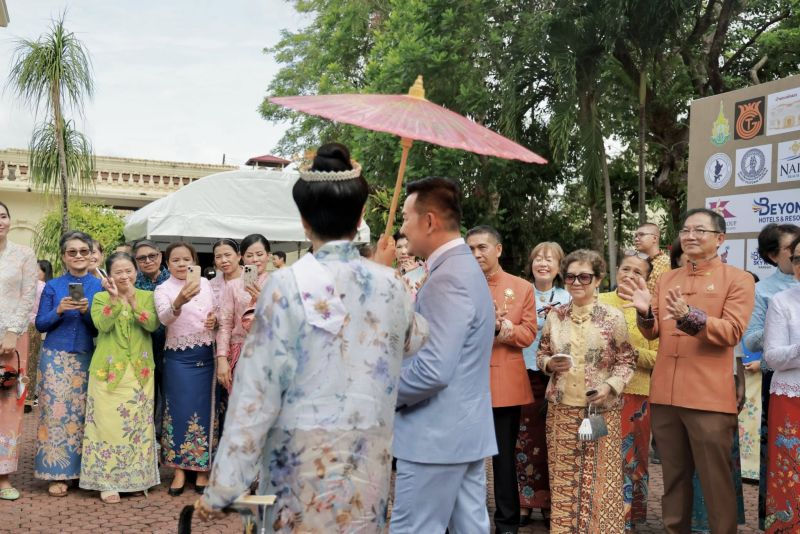
Traditional wedding customs, including tea ceremonies, ancestral rituals, and formal greetings to elders, were held at Ang Mo Lao, one of Phuket’s best-known heritage mansions.
The weddings reflect the unique culture of the Peranakan people — descendants of Chinese traders who married local women across the Malay Peninsula and Southeast Asia centuries ago. Also known as Baba Nyonya or Straits Chinese, the community blends Chinese, Malay, Indonesian, and later European influences into a distinct cultural identity.
Peranakan culture first emerged between the 15th and 17th centuries in areas that now form Malaysia, Indonesia, and Singapore before gradually spreading into southern Thailand, including Phuket.
During Phuket’s tin mining boom in the 19th century, Peranakan families became one of the island’s most influential social groups. While Chinese labourers worked in the mines, Peranakan merchants controlled trade networks, exporting tin overseas and importing goods, food, and cultural traditions in return.
Their influence shaped much of Phuket’s identity, from commerce and banking to architecture and cuisine. Many of Phuket Old Town’s famous Sino-Portuguese buildings were constructed during this era, combining Chinese and European architectural styles into the unique streetscape seen today.
One of the most recognised historical figures connected to this period is Khaw Sim Bee Na Ranong, an influential ethnic Chinese leader whose monument stands on Rang Hill in Phuket Town.
What makes Peranakan culture particularly distinctive is its ability to adapt and evolve while maintaining shared Chinese roots. Across Thailand, Malaysia, Singapore, and Indonesia, each Peranakan community developed its own local traditions, cuisine, and identity.
Food remains one of the clearest examples of this cultural fusion. Phuket’s famous Hokkien noodles, dim sum, and moo hong braised pork all trace their origins to Chinese culinary traditions but evolved differently through local influences over generations.
Even today, descendants of Peranakan families from multiple countries continue gathering in Phuket during cultural festivals, keeping the traditions alive while introducing new interpretations shaped by modern life.

The term “Peranakan” itself comes from the Malay language and means “descendant.” Meanwhile, “Baba” and “Nyonya” reflect the multicultural roots of the community — combining linguistic influences from Arabic, Persian, Indonesian, Portuguese, and other trading cultures that once crossed the Malacca Strait.
The annual Phuket Baba Wedding Festival has become more than just a ceremonial event. It now serves as a living reminder of how migration, trade, and cultural exchange helped shape Phuket into one of Thailand’s most unique historical and culinary destinations.


Comments